
 RFQ ()
 Sitemap
 Search
12.Volumetric Distributors Technological Applications: The Core Component of Centralized Lubrication Systems
Volumetric Distributors Technological Applications:
The Core Component of Centralized Lubrication Systems
In CNC machine tools, automated production lines, and high-precision manufacturing equipment, the stability of a Centralized Lubrication System has a direct impact on machine accuracy, operational reliability, and overall service life. Based on extensive service and maintenance experience, lubrication-related issues consistently account for a significant proportion of mechanical failures. Among these issues, inconsistent lubricant distribution is the most critical hidden problem.
Many machines operate smoothly during initial commissioning, but over periods of operation, symptoms such as accelerated wear, gradual loss of precision, and unexpected downtime begin to appear. These symptoms are often attributed to machine structure or aging. In reality, the main cause is frequently inconsistent lubricant volume delivered to individual lubrication points. Variations in pipe length, pressure distribution, and ambient temperature can cause critical components to remain in a long-term “sub-optimal lubrication” state, eventually leading to systemic failure.
For this reason, high-end manufacturing equipment widely adopts Volumetric Distributors (Positive Displacement Distributors) as the core element of Centralized Lubrication Systems. Unlike conventional Manifold Blocks that rely on flow balancing, Volumetric Distributors operate on a positive displacement metering principle, ensuring that each lubrication point receives a predictable, verifiable, and repeatable lubricant volume in every lubrication cycle. This fundamentally eliminates the risk of uneven lubrication.
Why Precise Metering Is Essential in Centralized Lubrication Systems?
Traditional lubrication systems often focus only on whether lubricant reaches the lubrication points, while overlooking whether the delivered volume is accurate and consistent. In reality, precise metering is a key factor in ensuring long-term machine performance and durability. Both insufficient lubrication and over-lubrication can cause irreversible damage to equipment.
Two Major Risks of Lubrication Imbalance
| Lubrication Condition | Primary Risks |
| Insufficient Lubrication | Increased friction, accelerated wear, and localized temperature rise, leading to loss of machining accuracy and premature equipment failure. When the oil film is insufficient, direct metal-to-metal contact significantly accelerates wear. |
| Over-Lubrication | Excess lubricant may cause sludge accumulation, seal damage, increased energy consumption, and environmental contamination. Under high-pressure conditions, oil leakage may further accelerate component degradation. |
How Volumetric Distributors Solve Uneven Lubrication?
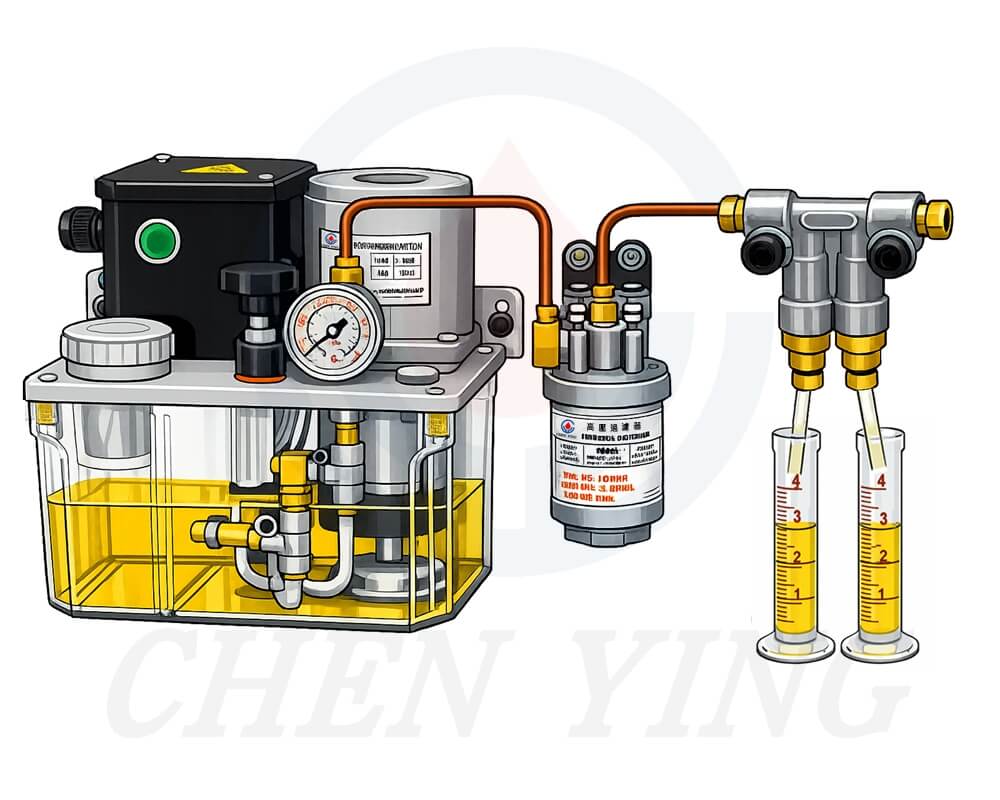
Volumetric Distributors are designed with a fixed-volume metering principle. The discharge volume of each lubrication cycle remains constant and is not affected by pipe length, pressure fluctuations, or ambient temperature changes. This design ensures that every lubrication point consistently receives the correct amount of lubricant.
By adopting Volumetric Distributors, lubrication management is elevated from simply “confirming oil flow” to precisely controlling the lubricant volume at each lubrication point. This effectively prevents uneven lubrication caused by system condition changes, extending machine life, and optimizing maintenance efficiency.
Operating Principle of Volumetric Distributors
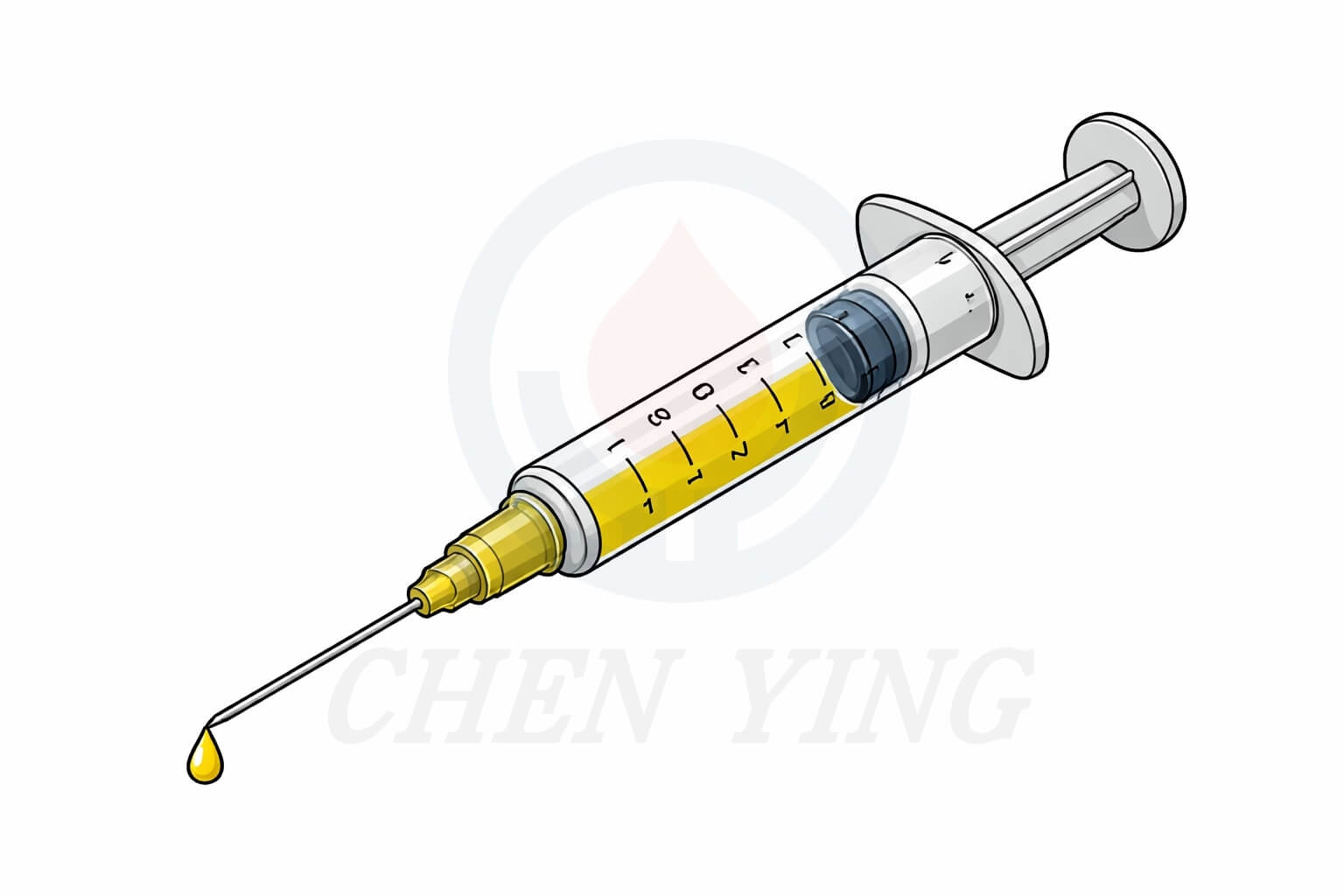
A Volumetric Distributor uses precision-machined internal piston chambers to deliver a fixed volume of lubricant during each lubrication cycle. Its operation can be compared to a precision metering cylinder: when system pressure drives the piston through a complete stroke, the pre-metered lubricant stored in the chamber is discharged to the lubrication point with high accuracy.
The core of this design lies in positive displacement metering, which is fundamentally different from Manifold Blocks that rely on orifices or flow balancing. As long as the piston completes one full stroke, a fixed lubricant volume is guaranteed. This is why Volumetric Distributors maintain high repeatability and accuracy under varying pressure, temperature, and lubricant conditions.
Two Operating Types of Volumetric Distributors
Volumetric Distributors can be classified by discharge timing into:
1.Pressure-Discharge Type Lubricant is discharged simultaneously when the lubrication pump is running. System pressure directly drives the internal pistons to deliver a fixed lubricant volume to each lubrication point.
2.Pressure-Relief Discharge Type Lubricant is stored within the distributor chambers during pump operation. When the pump stops and system pressure is released, the internal spring force returns the pistons and discharges the stored lubricant to each lubrication point.
Both types must be paired with Pressure-Relief Oil Lubricators (Pressure-Relief Lubrication Pump) to ensure complete and repeatable metering in every lubrication cycle.
Important Notice:
If a Volumetric Distributor is used with a Resistance Oil Lubricator (Single-Line Resistance Lubrication Pump) without a Pressure-Relief mechanism, residual line pressure cannot be released after each cycle. This prevents the internal pistons or springs from returning to their initial positions, causing gradual metering deviation and eventual insufficient lubrication, which accelerates abnormal wear.
Technical Comparison: Pressure-Discharge vs. Pressure-Relief Discharge
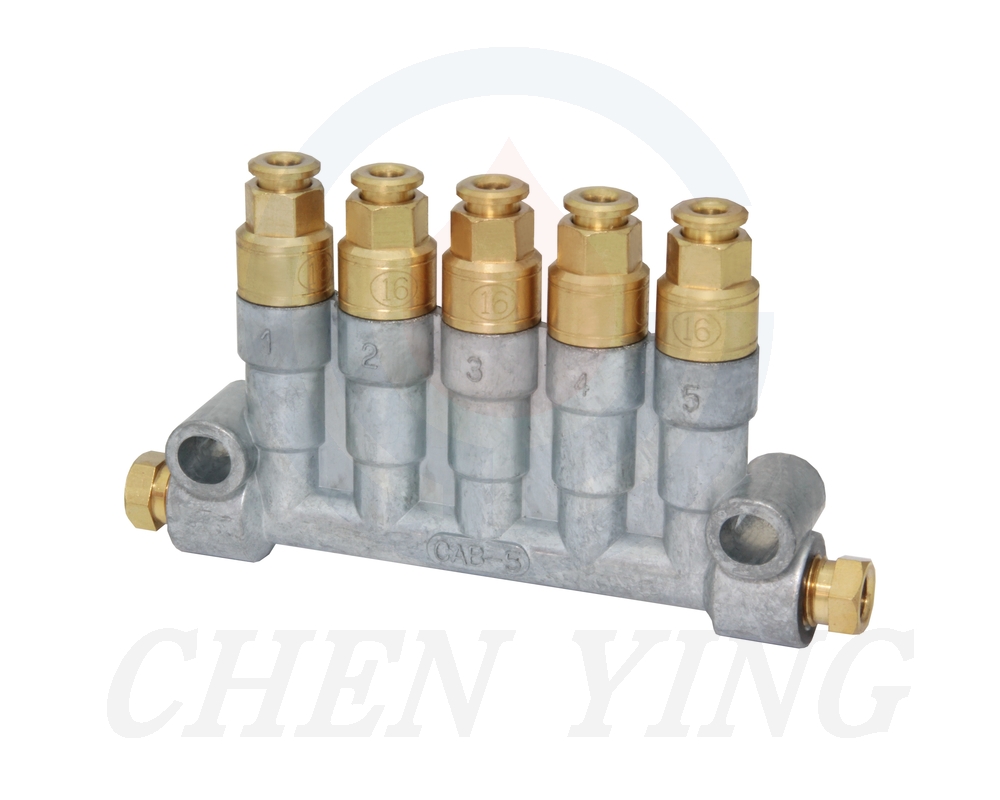
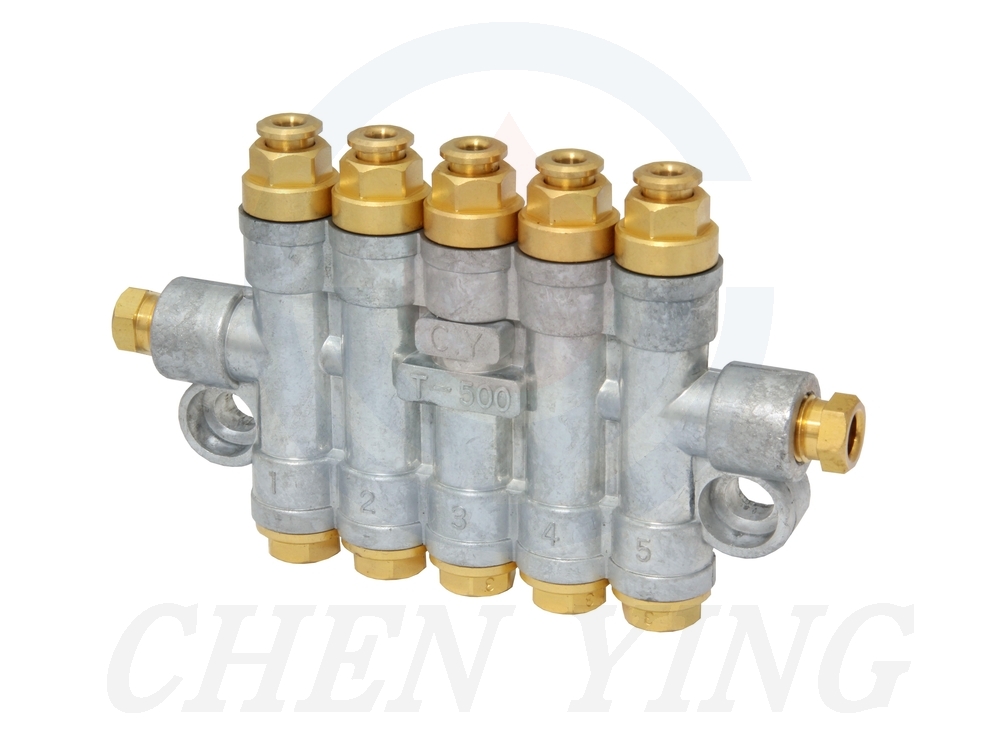
Item
Pressure-Discharge Type
Pressure-Relief Discharge Type
Operating Principle
Pump pressure directly drives pistons to discharge a fixed lubricant volume during motor operation
Lubricant is stored during pressurization; discharged by spring force after pressure relief
Discharge Pressure
Equal to main line operating pressure
Primarily generated by spring return force
Visual Confirmation
Not available; pressure switches required
Each outlet equipped with indicator pin
Suitable Equipment and Applications
Volumetric Distributors are particularly suitable for equipment with multiple lubrication points, high accuracy requirements, and long operating hours.
Typical Applications:
- CNC Machining Centers - Linear guideways, ball screws, tool magazine systems
- Lathes and Milling Machines - Slideways, spindle bearings, tailstocks
- Automated Production Lines - Multi-axis feed modules, robotic arm joints
- Woodworking Machinery - Sawing equipment, sanding machines, edge banders
- Packaging Machinery - Continuous-duty conveyor systems, folding mechanisms
- Printing Machines - Roller bearings, drive chains
- Plastic Injection Molding Machines - Clamping units, ejector systems
- Textile Machinery - High-speed spinning frames, weaving machines
Key Application Benefit:In these machines, lubrication imbalance rarely causes immediate failure. Instead, it leads to gradual loss of precision, which Volumetric Distributors effectively prevent this risk.
Modular Series Connection Design
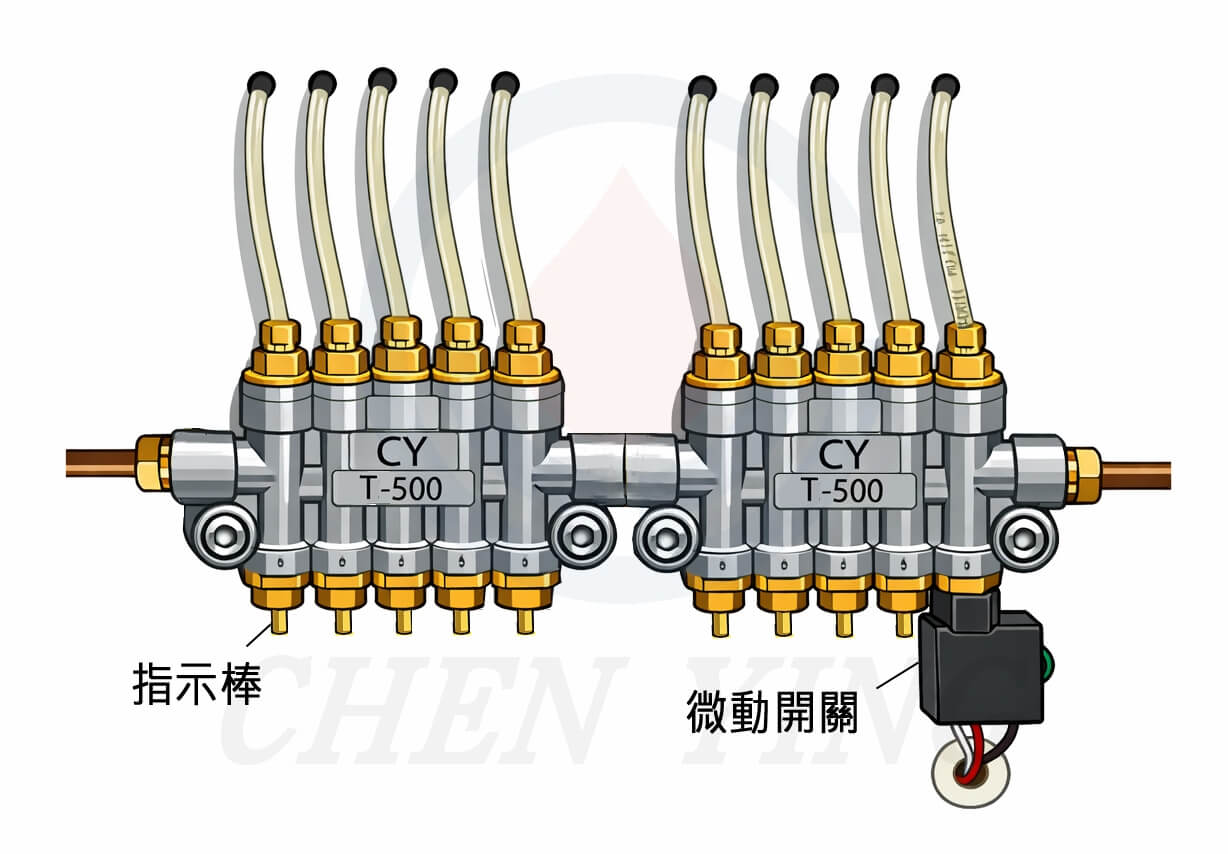
In practical installations, limited installation space or uneven lubrication point distribution is a common challenge. When a single distributor does not provide sufficient outlets, Chen Ying offers modular series-connection distributor assemblies. By using customized double connectors, multiple distributors can be compactly connected without replacing the entire lubrication system.
This modular design is especially suitable for medium and large-scale equipment, allowing a high number of lubrication points to be integrated with fewer inlets and simplified piping. This significantly reduces leakage risk, creates a cleaner piping layout, and improves overall system reliability.
Volumetric Distributor Selection Guide
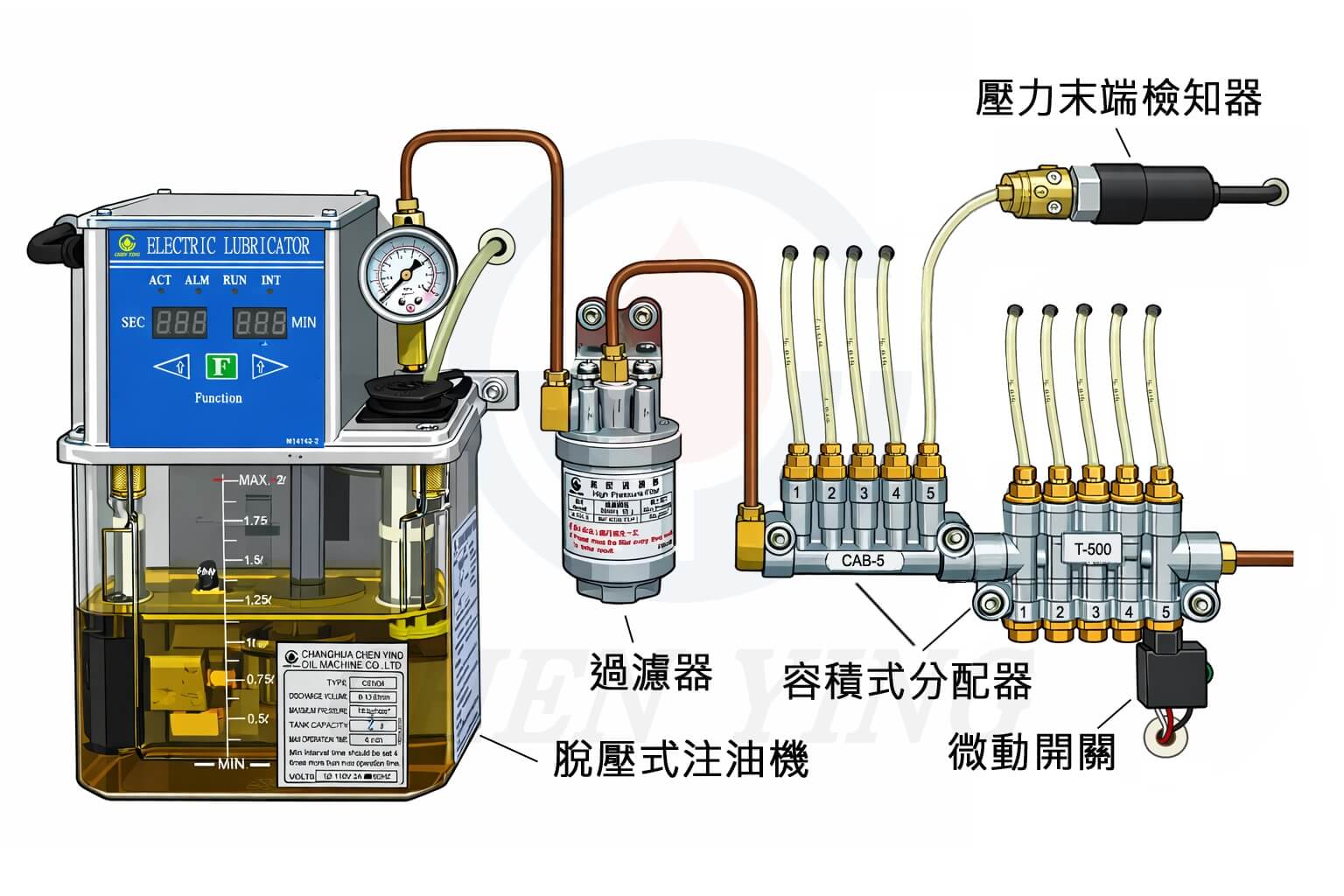
When selecting a Volumetric Distributor, four key factors must be considered: (1)lubrication system type, (2)discharge mode, (3)lubricant type, and (4)required output volume per point. In addition to single-cycle output volume, lubrication frequency, pipe length, and system operating pressure must also be evaluated.
Model Specification Overview
Model
Output Volume (cc)
Lubricant
Discharge Type
Lubrication System Type
T
0.1 / 0.2 / 0.3
/ 0.4 / 0.5
Oil
Pressure-Relief Discharge Type
Pressure-Relief Oil Lubricator
CDB
0.1 / 0.2 / 0.3
/ 0.4 / 0.5
Oil
Pressure-Relief Discharge Type
Pressure-Relief Oil Lubricator
CAB
0.03 / 0.06 /
0.1 / 0.16
Oil
Pressure-Discharge Type
Pressure-Relief Oil Lubricator
CBB
0.1 / 0.2 / 0.3
/ 0.4 / 0.5
Oil
Pressure-Discharge Type
Pressure-Relief Oil Lubricator
CCB
1.0 / 1.5
Oil
Pressure-Discharge Type
Pressure-Relief Oil Lubricator
CO/OA
0.03 / 0.06 /
0.1 / 0.16
Oil
Pressure-Discharge Type
Pressure-Relief Oil Lubricator
OC
0.01 / 0.03 /
0.06 / 0.1 / 0.16
Oil
Pressure-Discharge Type
Pressure-Relief Oil Lubricator
CFB
0.03 / 0.06 /
0.1 / 0.16 / 0.2 / 0.3 / 0.4 / 0.5
Grease
Pressure-Discharge Type
Pressure-Relief Oil Lubricator
Why Volumetric Distributors May Not Be Suitable for All Equipment?
Case Example: Swiss-Type Sliding Headstock Lathes
Certain sliding components are highly sensitive to instantaneous pressure changes. Without proper oil volume and pressure evaluation, the use of Volumetric Distributors may cause momentary pressure fluctuations during lubrication cycles, slightly lifting the slide and affecting machining accuracy and stability. In such applications, Manifold Blocks combined with metering fittings provide smoother oil delivery and improved operational stability.
Distributor Type Technical Comparison
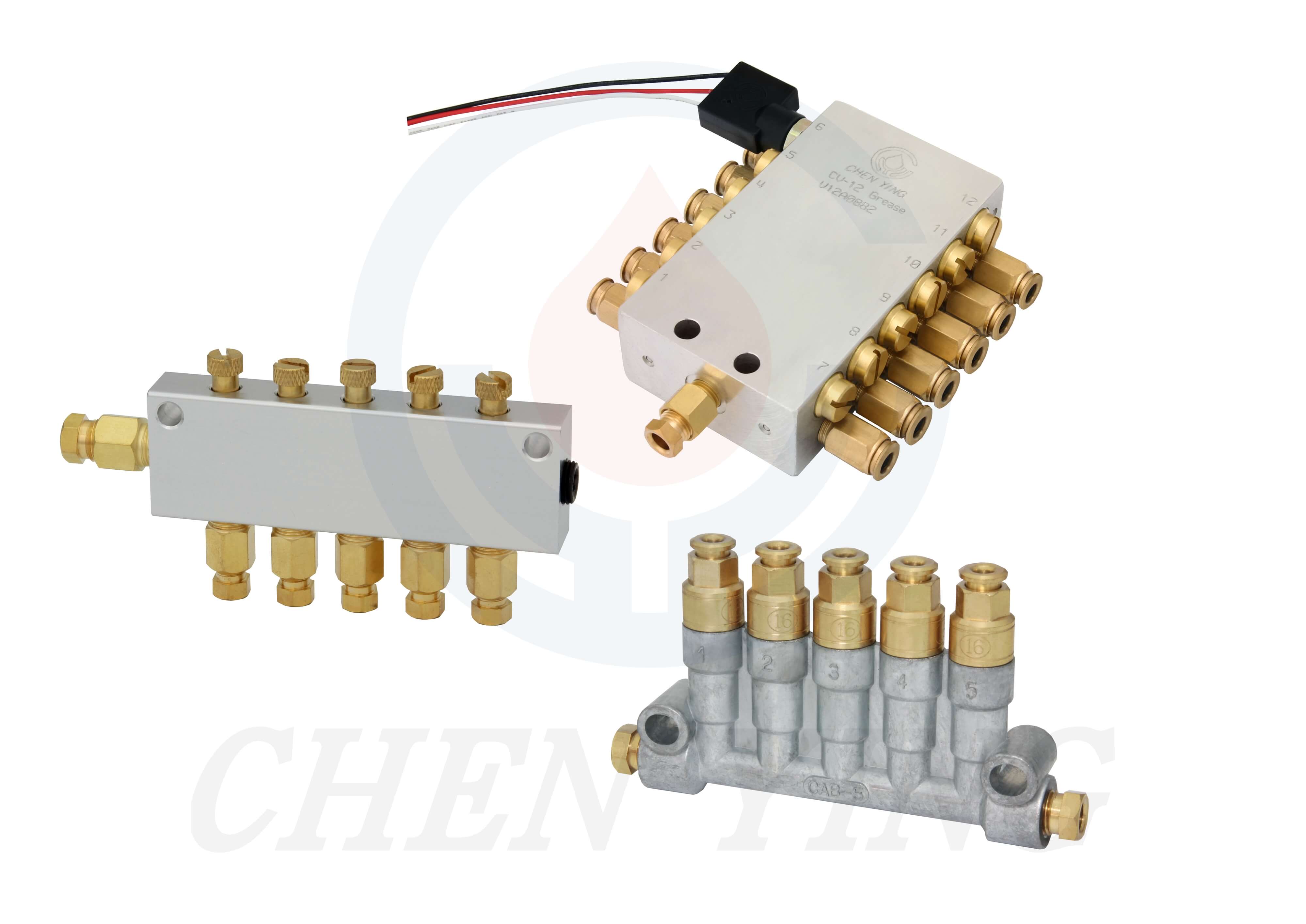
In a Centralized Lubrication System, the distributor design directly affects whether lubricant delivery can be accurately calculated, predicted, and maintained consistently over long-term operation. The following comparison highlights the key differences among three common distributor types from an engineering application perspective.
| Item | Manifold Block | Volumetric Distributor | Progressive Distributor |
| Metering Principle | Flow balancing through proportion adapters or metering fittings to distribute balanced oil | Fixed volume (positive displacement) | Sequential displacement |
| Lubrication Accuracy | Low | High | High |
| Temperature Sensitivity | High | Low | Medium |
| Lubrication Point Consistency | Low | Excellent | Good |
| Blockage Impact | Affects overall distribution | Affects only the blocked point | Entire cycle stops |
| Lubrication System Type | Resistance Oil Lubricators | Pressure-Relief Oil Lubricators | Resistance Oil Lubricators |
| Cost | Low | Medium | High |
Selection Recommendations
- Maximum precision and calculability → Volumetric Distributor
- System monitoring and abnormality detection required → Progressive Distributor
- Simple structure, cost priority, low precision demand → Manifold Block
In practice, Volumetric Distributors or Progressive Distributors are often used as the core to balance precision and reliability
Industrial Value of Volumetric Distributors
For machine builders and end users, Volumetric Distributors provide far more than lubricant delivery::
- Predictable and verifiable lubricant volume
- Long-term system stability without performance degradation
- Reduced unplanned downtime caused by lubrication imbalance
- Extended service life of critical components and entire machines
- Lower overall lubricant consumption
The core value of Volumetric Distributors lies in delivering predictable, repeatable, and verifiable lubrication during every lubrication cycle. For modern industrial equipment pursuing machining accuracy, operational stability, and long service life, Volumetric Distributors are no longer optional—they are an essential core component of Centralized Lubrication Systems.
Frequently Asked Questions
1.What is a Volumetric Distributor?
A Volumetric Distributor is a positive displacement lubricant metering device used in Centralized Lubrication Systems. It delivers a fixed and repeatable volume of lubricant to each lubrication point during every lubrication cycle, ensuring consistent lubrication regardless of differences in pipe length, operating pressure, or system configuration.
2.When should a Volumetric Distributor be used instead of a Manifold Block?
A Volumetric Distributor is recommended when every lubrication point requires an accurate and repeatable lubricant volume. It is particularly suitable for CNC machine tools, automated manufacturing equipment, and high-precision machinery. A Manifold Block is generally preferred for simpler lubrication systems where precise metering is not critical.
3.Can Volumetric Distributors be used with any lubricator?
Volumetric Distributors must be paired with Pressure-Relief Oil Lubricators (Pressure-Relief Lubrication Pump) to ensure accurate metering. Using Resistance Oil Lubricators (Single-Line Resistance Lubrication Pump) may cause metering deviation due to residual line pressure.
4.Does lubricant viscosity or ambient temperature affect metering accuracy?
Due to the positive displacement metering principle, Volumetric Distributors are minimally affected by oil viscosity or ambient temperature variations under normal operating conditions.
5.How can distributor operation be monitored?
Chen Ying T-Type and CDB-Type Volumetric Distributors are equipped with Industrial Value at each outlet for visual confirmation. These pins can be combined with a proximity switch or sensor switch to convert visual inspection into signal monitoring. Other models require pressure switches for electronic monitoring.
6.Do Volumetric Distributors require regular maintenance?
Although Volumetric Distributors require very little maintenance, periodic inspection of lubricant cleanliness, piping condition, and proper piston operation is recommended to ensure long-term metering accuracy and system reliability.